
 Grand Army Plaza, Brooklyn

Bridge of laughs
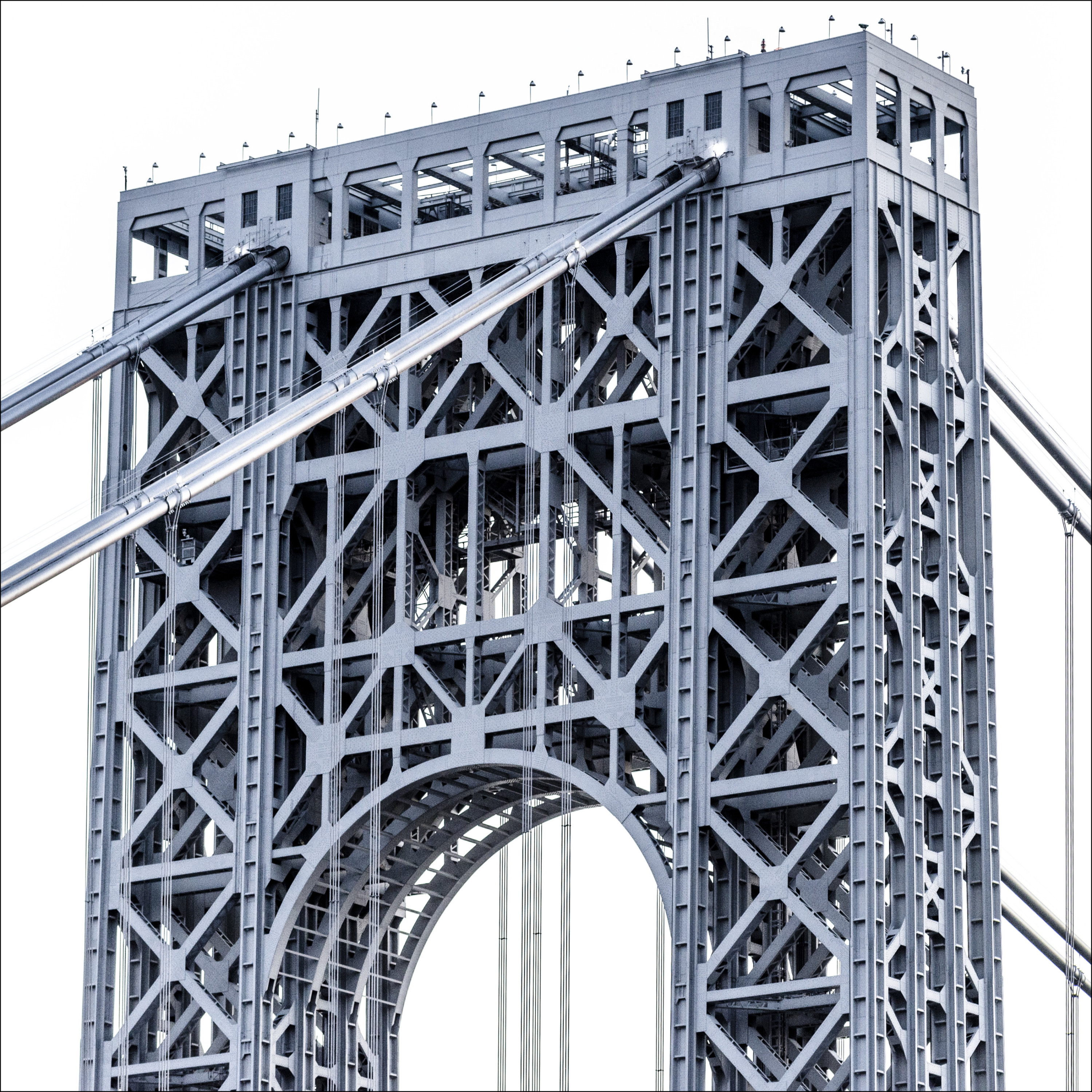 George Washington Bridge, viewed from West 181st Street and Riverside Drive in Manhattan.
The George Washington Bridge over the Hudson is the most beautiful bridge in the world. Made of cables and steel beams, it gleams in the sky like a reversed arch. It is blessed. It is the only seat of grace in the disordered city. It is painted an aluminum color and, between water and sky, you see nothing but the bent cord supported by two steel towers. When your car moves up the ramp the two towers rise so high that it brings you happiness; their structure is so pure, so resolute, so regular that here, finally, steel architecture seems to laugh.
— Le Corbusier
When the Cathedrals were White (1947)

King v. Burwell – place bets gentlemen
Before oral arguments even begin this morning, I’m going to go way the hell out on a limb and predict the final outcome.
It will be 5-4 in favor of the government. Either (i) Roberts will write the opinion of the Court, joined by Breyer, Ginsburg, Kagan and Sotomayor, or (ii) there will be no majority opinion, with Alito, Kennedy, Scalia and Thomas on one side, Breyer, Ginsburg, Kagan and Sotomayor on the other, and Roberts siding with the government but writing only for himself. There is a slight possibility that Kennedy would join a majority opinion, leaving Roberts free to hang with the boys, but I’m counting on him to flake out with a literalist approach to the statutory language.
I take it as a given that Chevron deference to agency interpretation is a dead letter with the Court’s right wing, at least when the agency is the IRS and a Democrat is in the White House. But the more interesting discussion – which I expect to dominate today’s argument – is around Constitutional federalism and the Pennhurst doctrine, basically the idea that if Congress is going to place conditions on States’ entitlement to federal funding, it had better do so clearly and unambiguously, sort of like an “actual notice” requirement. Whatever else those four words in 26 U.S.C. § 36B may mean to a committed textualist, no one can seriously claim that Section 36B put States on Pennhurst-worthy notice that they would lose Obamacare subsidies if they didn’t set up their own exchanges. But since Alito, Scalia and Thomas have given up on being serious, that is probably what they will in fact claim.
Again assuming that Kennedy joins the nihilists, I think Roberts will use Pennhurst to thread the needle, prevent a humanitarian disaster and, once again, be the lonely steward of the Court’s reputation. His one-man opinion will uphold the IRS regulations, essentially by saying that if the IRS had instead withheld Obamacare subsidies from states that didn’t set up their own exchanges, it would have violated principles of Constitutional federalism under Pennhurst. The four liberal Justices may join Roberts’ opinion (making it an opinion of the Court), but I think it’s at least as likely that they will write their own opinion, basically on Chevron or general “don’t waste my time with this nonsense” grounds. The main reason I think that may happen is because Roberts will go a little too far with his Pennhurst logic in an attempt to snatch a conservative victory from the jaws of Obamacare defeat, and try to sneak in a brand new way for States to challenge federal mandates. (That federalism stuff is dangerous, I tell you.) So Roberts will be on his own, much as he was with his taxing power argument in NFIB v. Sebelius.
Well. Now I’m feeling exposed. Still, I hope I’m right. All this nifty argumentation aside, if the challengers win this one, with full knowledge of how many people will die as a direct result, they’re not just vandals – they’re terrorists.
Was Bush lying or was he stupid? Yes.
At least Silberman acknowledges that the WMDs didn’t exist, and that our war aims depended on the existence of WMDs. And by doing so, Silberman implicitly accepts that the invasion of Iraq – and not merely the intelligence failures leading up to it – was a colossal foreign policy and military blunder with enormous costs in blood, treasure and prestige. Quibbling about whether President Bush (as opposed to the Bush Administration) lied (as opposed to being merely prone to confirmation bias) is, to me, a distraction from what might be learned from a tragic failure of governance and leadership.
Which leads me to say, okay, President Bush (the person) didn’t (knowingly, willfully) lie. So what? What, exactly, does that prove about the stupidity and fecklessness of government in the 21st century – just a few years following the end of a long cold war during which, through a combination of smarts, moral courage, rigorous analysis, skepticism and, yes, basic humanity did we (and the Soviets), our immense nuclear arsenals on hair-trigger alert, still manage not to wipe out civilization? If intelligence failures up the US chain of command had resulted in our launching a nuclear first strike against the Soviet Union and their launching a retaliatory strike against the United States, would the fact that the President’s own personal conduct wasn’t to blame have helped one God-damned thing? Have we really defined Presidential leadership down to this extent?
Another way that Silberman’s analysis oversimplifies and distracts is by setting up the “intelligence community” and the “Bush Administration” as separate entities operating at arm’s length. I think anyone who understands how government institutions operate, especially at the executive policy-making level, knows that individuals from different offices, agencies and even branches of government tend to create informal alliances and networks that share information and access and pursue common policy agendas. Nothing especially nefarious about this – but these alliances and networks do tend to obscure whether someone is “pressuring” someone else to make a particular finding. In other words, the fact that elements of the intelligence community and the Bush Administration were working together with the shared goal of invading Iraq (apparently on the basis of any plausible pretext) makes it next to impossible to find the smoking gun evidence that Silberman seems think is necessary to conclude that any arm-twisting took place.
Look. As I am forever reminding you, this is the government we’re talking about. Government agencies and their agenda-setters come up with ideologically motivated, poorly reasoned findings as a matter of utmost routine. Want the CIA to say that Saddam has WMDs? The neoconservative alliance says: here you go. Want the Treasury Department to say that asset management firms can threaten financial stability? The market risk hysteria network says: coming right up. There is no difference between the two except in terms of their potential for death and destruction. Anyone who automatically gives more deference to police/military/intelligence agencies just isn’t thinking clearly.
Gone Gallagher
Speaking of the overall dickishness at the SEC, you should Google “Gallagher Grundfest Harvard” and read about how Dan Gallagher (that flaming asshole) abused his office by accusing the Harvard Shareholder Rights Project of securities fraud – not as part of an SEC proceeding, but in an academic paper he co-authored with Prof. Grundfest – securities fraud supposedly perpetrated when the Harvard SRP made filings in support of Rule 14a-8 shareholder proposals to de-stagger boards of directors at a number of publicly traded corporations and, Gallagher alleges, mischaracterized the academic literature as overwhelmingly in support of de-staggering, when in fact there is a “substantial” body of research that favors leaving staggered boards as they are.
Leaving aside the merits of Gallagher’s views and his unctuously pro-management, anti-activist tone (at least we now know what he’s planning to do when he leaves the SEC), how can it possibly be appropriate for an SEC Commissioner to accuse private individuals or organizations of Rule 14a-9 violations or other securities fraud in the absence of any SEC proceeding or investigation? Even where (maybe especially where) current SEC Staff policy makes it very unlikely that the underlying conduct would ever be the subject of an enforcement action? Since when is an SEC Commissioner permitted to pronounce violations of the Federal securities laws, using his own preferred interpretation, on a freelance basis?
Over the line! Gallagher must go! I’m sure there’s a lobbying job for him at Americans For Entrenched Management or The Impunity Society or someplace like that.
I condemn
These extremist practices do not represent Judaism, a religion of peace and good hygiene. I call on all Jews of good conscience to reject the perversion of our religious traditions by militant fellatists.

DiFi tortures the CIA
Here’s an email I just sent to everyone in my firm:
| The report of the Senate Select Committee on Intelligence was released a few minutes ago. It can be downloaded here. Everyone should read as much of it as they can bear. |
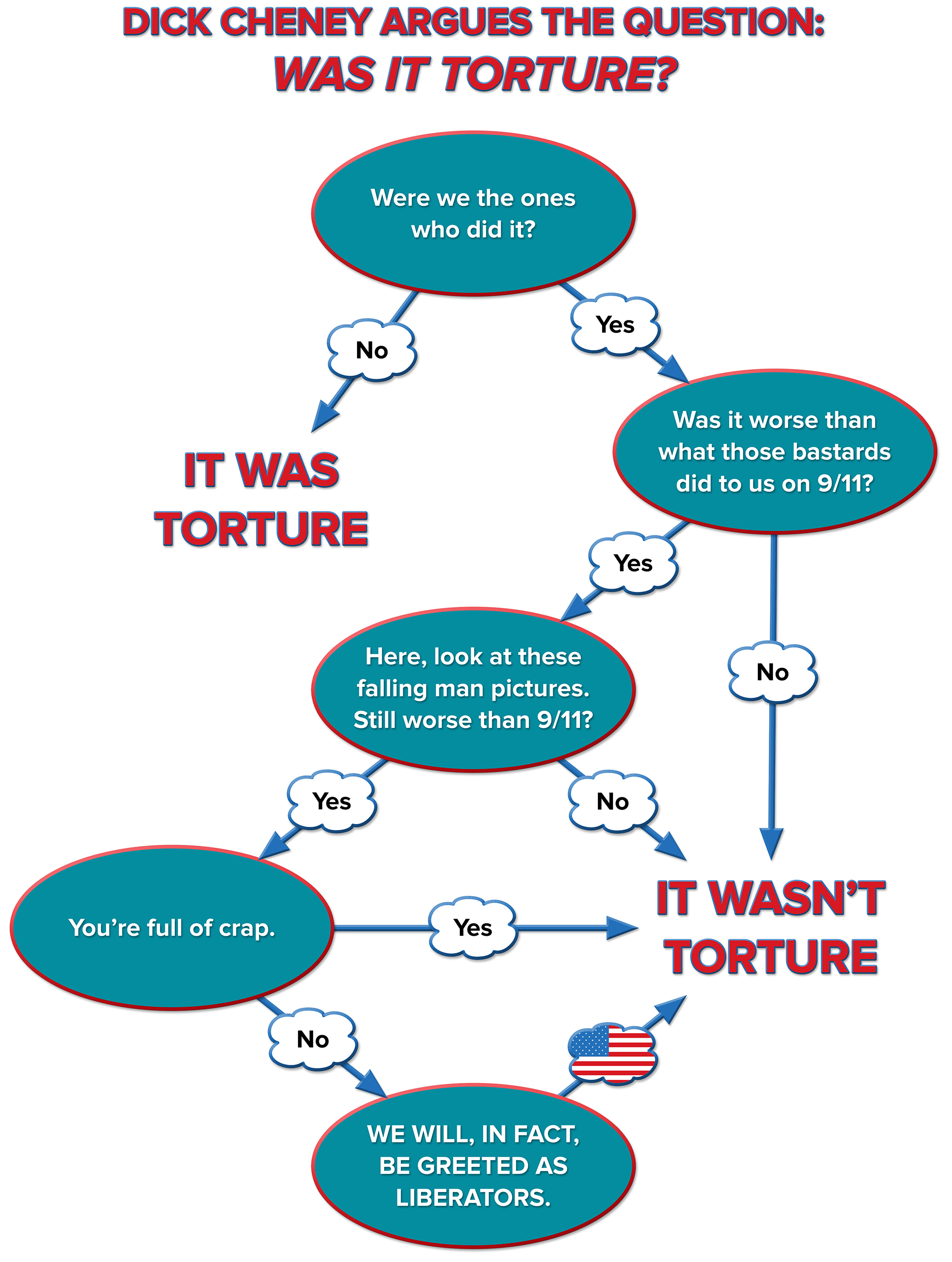
| Barest summary of the report: In the years after 9/11, the CIA systematically tortured terror suspects and other detainees pursuant to orders from the Executive branch. Senior members of the Bush Administration (presumably including Vice President Cheney) committed war crimes, in knowing violation of both international and US law, under cover of deliberately shoddy and misleading legal advice from, among others, a sitting Federal judge. No one will be prosecuted. |
| The report’s most important conclusion: The torture yielded no actionable intelligence, a fact that should finally put an end to the specious arguments about ends and means. That torture doesn’t “work” is not a surprise. Torture isn’t, and wasn’t, about extracting information. It is, and was, about power, revenge, rage and cruelty. Certainly, torture isn’t a sign of strength, or moral clarity in the face of existential danger. It’s a sign of fear and, ultimately, weakness. |
| Justification for this email: If a meaningful distinction can be made between “law” and “politics” – and, by extension, between what is and what is not appropriate for workplace discussion – my considered judgment is that the attached Senate report is concerned with issues of law. At the very least, the report (in its discussions of the Yoo and Bybee memos) highlights the ethical lapses lawyers can commit when pressured by important clients to reach a favorable conclusion. |
| Jeff |