








Post-election outreach to clients—what’s really at stake?
I’ve been asked what it was that made me so uncomfortable about putting out a standard post-election memorandum to clients describing potential regulatory changes under the new Administration. I’ll get to that in a moment. Now, it’s time for us to heal the bitter divisions, join together as one nation, and consider how we defend our country, our clients and ourselves from the dangerous tyrant we just elected President.
Donald Trump—President Donald Trump!—threatens national security and menaces the rule of law. By his own statements, anyone can see that the man stands far outside the norms that have guided our democracy and its leaders for 240 years. He’s functionally illiterate and may be uneducable. He appears to have a range of diagnosable personality disorders.
This is not just me on a rant. This is a widespread, bipartisan, across-the-spectrum opinion. The only thing the people who hold this view have in common is an ability to see a picture of the national interest bigger than the potential for career advancement or revenue opportunities.
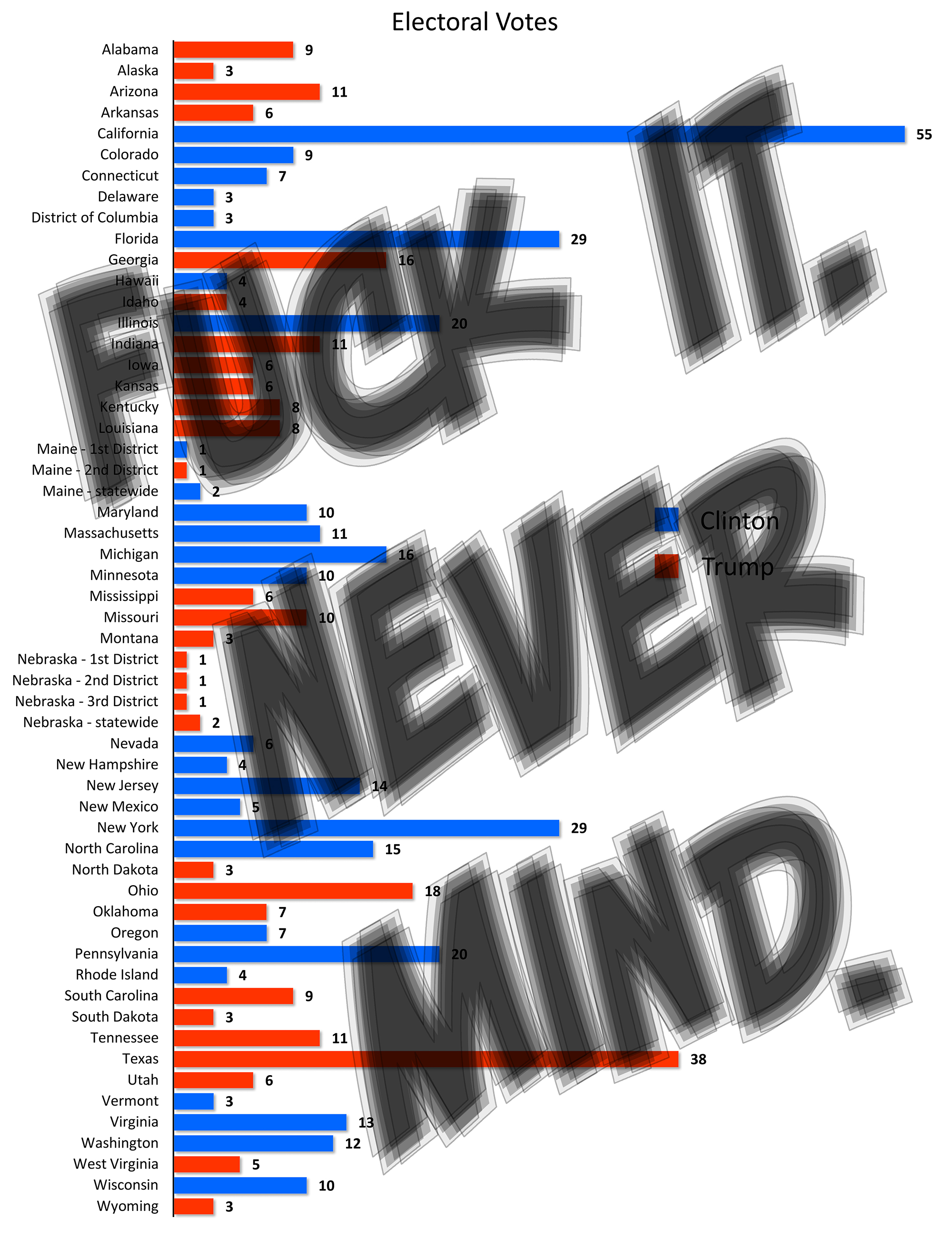
And yet here we are, only three days after the election and already entering the “normalization” phase: the President-elect sits down with the President, the First Lady-elect has tea with the First Lady, there is news of transition teams and cabinet appointments, and law firms talk to clients about legislative and policy initiatives to expect from the incoming Administration.
That’s what made me so uncomfortable about publishing a standard post-election client memo. By treating this like any other Presidential transition from one political party to the other, the memo would have helped (albeit unintentionally) to normalize Trump and, as a result, would have misled our clients about what they really have at stake.
■
 Most of our clients are participants in regulated markets of one kind or another and, as we all know, have made the management of regulatory risks and enforcement risks a core element of their strategies and a key driver in almost every decision-making process.* The regulatory risks (or perhaps I should say benefits) posed by the incoming Trump Administration may well be more or less what you’d expect from a conventionally conservative Republican-led government that stands for lower taxes and rising sea levels, and so our clients may feel free to mutter “excellent” while steepling their fingers, Mr. Burns style.
The enforcement risks are another matter entirely.
I’ll cut to the chase. The single most salient thing we can say to our clients about the incoming Trump Administration is that investigative and prosecutorial discretion—and the degree to which firms need to factor into their risk management protocols the potential for abuse of that discretion—may be about to change, big-time.
Donald Trump has already made very clear his interest in the retaliatory potential of the Presidency. He has already announced an intention to use his executive power to punish his opponents and critics; already suggested that he would order the Department of Justice and various other agencies of the Federal government’s administrative and law enforcement apparatus to abuse their investigative and prosecutorial discretion by targeting his enemies. That is what Trump has said. Is it unfair or unseemly to take the President-elect at his word?
Above almost all else, our clients depend on the rule of law. The possibility of investigative or prosecutorial misconduct—that is, the chance that firms could become the targets of investigations or enforcement proceedings arbitrarily and for reasons unrelated to their regulatory compliance record—makes it exceedingly difficult for our clients to manage enforcement risks on any rational, cost/benefit basis. Adding to the costs of prosecutorial misconduct are the various collateral consequences that increasingly attach to enforcement determinations and the profound disruptions that even a civil investigation can cause for many firms in regulated industries.
I think we owe our clients an even-tempered evaluation of the possibility, based on widely reported statements, that the Trump Administration would commit abuses of investigative and prosecutorial discretion by targeting individual firms or entire industry sectors on a retaliatory basis. We should include a summary of the Federal government’s institutional defenses against such abuses, from the investigative guidelines adopted by past Attorneys General and the rules against White House interference in DOJ decision-making to the institutional cultures of the DOJ and other Federal law enforcement agencies. We should be frank about how fragile those institutional defenses may be when under sustained attack.
A memo like this would be far more valuable to our clients than the usual “what to expect from the new Administration” fare. And I think we would get some very positive feedback and high scores for originality and daring. Best of all, we would ensure that our Firm does its part to keep Donald Trump on the far side of normal where he belongs until, at long last, he resigns or is impeached.
■
Go ahead, call me hysterical. But when the history of this awful chapter is written, big-firm lawyers will be Exhibit A in the account of how Trump was “normalized” after the election and how the rule of law was left unattended and at risk. Maybe that’s what we’ve become. Standing on abstract principles like “rule of law” is so last-century; we have a business to run and our commercial interests appear best served by speaking sweetly to power. Big-firm lawyers aren’t alone, of course: all the other professional service businesses that comprise the flattering classes, all of us whose primary function is to protect and defend the wealth of others, seem to have the same means of self-preservation. We assume no one would want us to focus on long- or even medium-term risks to fundamental rights or the rule of law—not when tax cuts and financial deregulation are right around the corner. So we normalize the greater threat and hype the “opportunities” for our clients. I guess we’ll see what happens next.
* For present purposes, when I say “regulatory risks” I mean the risks that the adoption of new or amended Federal laws, regulations and agency interpretations will affect a client’s costs of engaging in regulated activities. When I say “enforcement risks,” on the other hand, I mean the risks that a client’s compliance with existing Federal laws, regulations and agency interpretations will become the subject of an investigation or enforcement proceeding brought before a Federal administrative or law enforcement agency and, in cases of alleged criminal violations, referred to the US Department of Justice.